
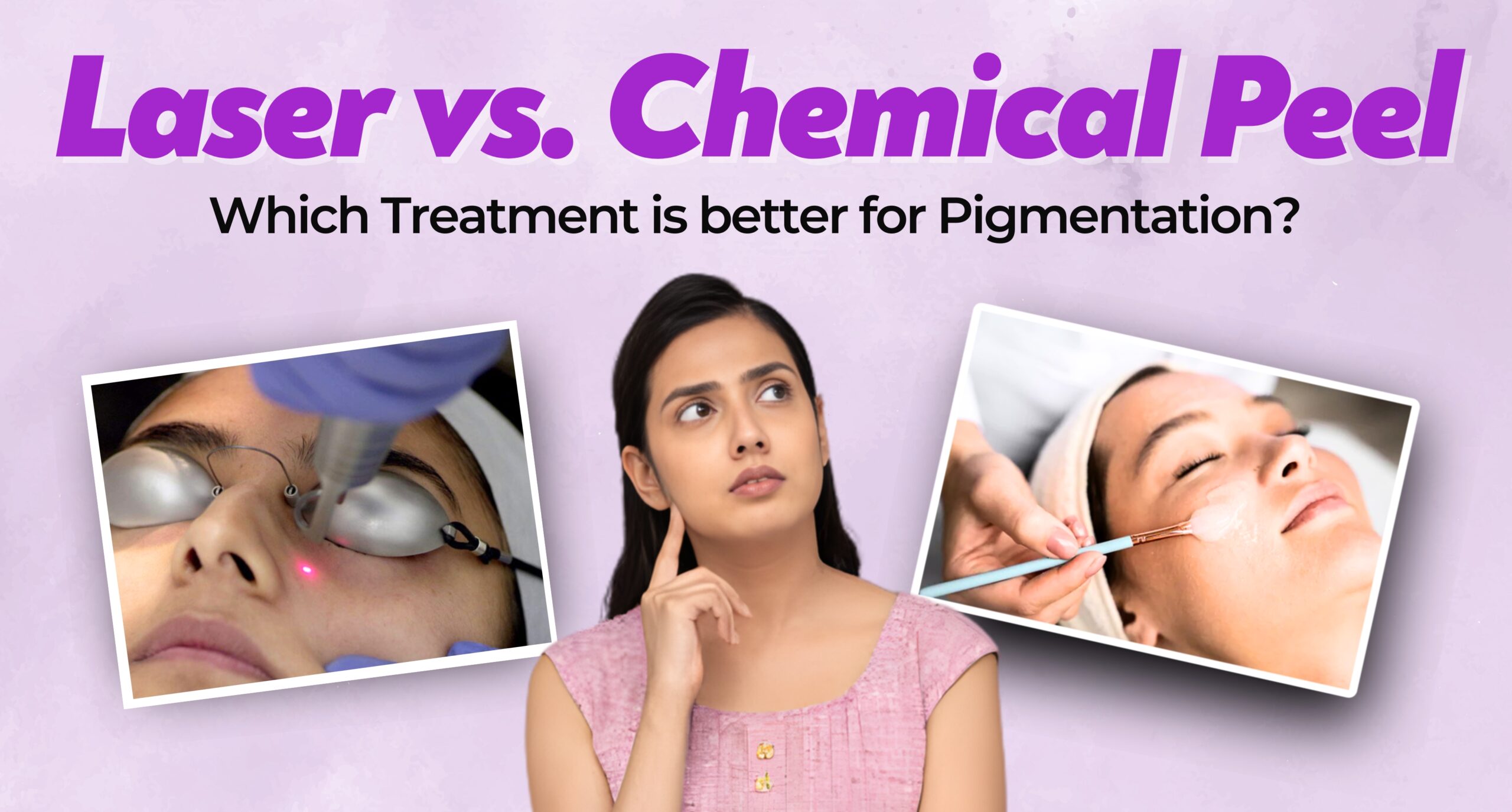
Quick Summary (TL;DR)
A common skin worry that people from all skin types experience, especially in Indians, is skin pigmentation. The ever-growing “Laser vs Chemical Peel” dilemma has always left people doubting the effectiveness of one over the other regarding the issue of pigmentation. In this CosmoLooks guide, you will learn about the procedures involved, the type of people that should opt for each process, and how dermatologists choose which one to opt for
If you have already attempted creams and serums, you most probably find yourself looking at more advanced solutions. In fact, one of the top inquiries that a patient may have is, “What is the difference between a chemical peel and a laser treatment when it comes to treating hyperpigmentation?”
“The skin pigments may come as dark spots, melasma, tanning, spots caused by acne or patchy skin.” While both laser and chemical peeling are proven procedures, they use two distinct processes. “At CosmoLooks, we firmly believe that skin pigments should never be treated as a universal condition,” reiterated the dermatologists, adding that a custom treatment should be adopted as it may not suit all skin types and patterns.”
Key Takeaway:
Laser and chemical peels are both effective pigmentation treatments, but they work at different skin depths. Lasers target deeper, stubborn pigmentation such as melasma and dermal dark spots, while chemical peels are better suited for surface-level pigmentation, tanning, and post-acne marks. The most effective results often come from a dermatologist/cosmetologist guided, combined approach based on skin type and pigmentation depth.
These treatments are offered at CosmoLooks clinics across major cities in India, where personalized pigmentation plans are designed after in-clinic skin evaluation.
Pigmentation
Skin pigmentation is caused by the excessive production of melanin in the skin. Melanin is the pigment found in the skin that causes skin color. But when it is produced in excess amounts, the result is skin pigmentation
Frequent Causes of Skin Pigmentation
- Excessive exposure to the sun without protection
- Hormonal issues including pregnancy, PCOS and taking Oral Contraception Pills
- Post-acne inflammation
- Genetic predisposition
- Skin injury or aggressive cosmetic procedures
- Certain medications
According to dermatological research, more than 70% of Indians are prone to have some sort of hyperpigmentation in their mid-30s. This is one of the reasons why the need for the right treatment is so important in melanin-rich skin.
Hold Key: The extent of pigmentation affects not only surface treatments, but also their depth.
Laser and Chemical Peel: Which Is More Promising for Skin Pigmentation?
In this scenario, professional evaluation becomes indispensable. Although both options work to decrease pigmentation, they work on different levels of the skin.
Major Differences at a Glance
- The lasers specifically focus on the melanin with the help of light energy
- Lasers provide a higher degree of precision on areas with deeper pigmentation
- Peels act slowly, and the effect is largely on the surface pigmentation
This depends on the extent of pigmentation, skin sensibility and history of recurrence.
Takeaway: The type of treatment that’s best for your skin has nothing to do with trends and everything
Process of Laser Therapy in Pigmentation
The laser therapy involves using light energy in a controlled manner to reduce or remove excess melanin.
Laser Treatments for Pigmentation: Understand What to Expect
- The laser beams are directed at pigment deposits just below the surface of the skin
- Heat decomposes the melanin into fine particles
- The body has a natural ability to remove these particles
- Skin color will eventually become more even
At CosmoLooks, FDA-approved lasers that match Indian skin tones are employed to minimize any risk of burns and/or post-inflammatory pigmentation.
When the Laser Therapy Are Recommended
- Deep or dermal pigmentation
- Acne Marks and Scars
- “Sun spots” resistant to topical creams
- These spots are
- Skin with uneven tone due to tanning
Experience has shown that there is a 60 to 80 percent decrease in the amount of skin pigmentation after a structured course.
Takeaway: Laser therapy is more suited to treating deeper stubborn pigmentation combined with plasma therapy it is one of the best options
The Chemical Peel Process Relating to Pigmentation
Chemical peeling involves the use of medical-grade acids to exfoliate and induce new cellular renewal on the skin.
Types of Chemical Peeling
Surface peels: Gently exfoliate dull skin, achieve a light tan
Medium peels: Acne scars and pigmentation problems
Step
Advanced peels: Carefully-controlled treatment for melasma and longstanding pigmentation
The most common active ingredients used are glycolic, salicylic, lactic, and mandelic acids, depending on skin type.
When Chemical Peels Are Recommended
- Acne dark spots
- Uneven texture and lack of brightness
- First-time pigmentation Treatments
Peels are normally undertaken in a course, where the results can be noticed in 3 to 4 treatments.
Takeaway: Chemical peels are best for the treatment of surface pigmentation.
Laser vs Chemical Peel: Which is More Effective on Indian Skin?
The Indian skin contains high levels of melanin. It is therefore sensitive to heat and aggressive treatments. This is why it is important to be supervised by a dermatologist.
Safety Factors
- Laser parameters need to be adjusted according to the Indian skin type
- Chemical peels have to be chosen correctly to avoid burns
- Sun protection is mandatory.
- Sunblock
- Maintenance therapy prevents recurrence
However, in most cases, dermatologists are found to practice the combined approach. For instance, the laser therapy is utilized for treating deeper pigmentations on the skin, while peeling
Takeaway: A combination and staged approach is most suitable for Indian skin.
How Dermatologists Choose Treatment for Patients at CosmoLooks
Each pigmentation procedure at CosmoLooks starts with a consultation.
Dermatologist Decision Process
Analysis of the skin to determine depth and type of pigmentation
Medical history including hormonal matters and allergies
Lifestyle Assessment: This includes sun exposure and skincare routines
Treatment mapping: laser, peel, or a combination of both
Sun protection products and medical-grade skin care products for aftercare planning
For the patient, more lasting clarity is achieved through the combination of the laser treatment and the mild peels and skin care recommendations from the dermatologist.
Conclusion: The importance of an expert’s judgment in order to treat a patient in a safer way.
Conclusion
When it comes to a comparison between a laser peel and a chemical peel, it’s not necessary to choose between the two. While a laser has a faster treatment speed and penetrates deeper to eliminate problematic pigments, a chemical peel is also a skin smoothening formula.
At CosmoLooks, dermatologists also create customized therapy plans for pigmentation removal focusing upon the aspect of safety, efficacy, and sound skin care. If pigmentation affects your confidence, the time has come to make the right choice.
You can schedule your consultation by visiting www.cosmolooks.in and begin your journey to clearer and equal-toned skin.
Frequently Asked Questions
1. Is laser better than a chemical peel for pigmentation?
“Lasers are more effective than chemical peels in removing deeper pigmentation. However, chemical peels are good for removing lighter patches on the skin’s surface.”
2. Can chemical peels cause skin pigmentation to worsen?
Yes, if done improperly or without adequate sun protection post-procedure. This can be avoided by following a procedure under supervision and tailoring a treatment plan.
3. How many laser treatments are required for pigmenation removal?
Typically, 4 to 6 treatments are required depending on how deep or sparse the pigment is, as well as your skin reaction. The dermatologist will prescribe a treatment plan.
4. Will there be downtime following these procedures?
Chemical peels could cause peeling, which could last for a few days. The Laser treatments would mostly have minimal downtime, with some redness in the beginning.
5. Can laser peels be done in combination with chemical peels?
Yes. Dermatologists combine both to achieve better results. While lasers remove pigments, peels keep the skin clear.



No comment